The Land Institute
March 8, 2024 | Salina, KS
We met our guide at the prairie field in front of the research facility. She begins our tour by explaining the founders of The Land Institute, Wes and Dana Jackson, were motivated to study and recreate the historical prairie lands of Kansas. Before the settlers arrived and cleared the land for agriculture, Kansas was prairie land. These self-sustaining natural systems supported life above and below the topsoil. Above, the prairie lands fed bison, deer, and elk. The vast colorful flowers fed the pollinators. Below the surface, deep root systems created rich nutrient-dense soil, supporting fungi and bugs. Occasionally lightning would initiate wildfires clearing dead plant matter, releasing nutrients, and promoting new growth. The concept of self-sustaining farm lands has inspired nearly 50 years of research.
The Land Institute's purpose is to develop agricultural systems that work with nature to feed humanity and repair our environment. They see perennial crops as the key solution.
Perennial Wheat, Kernza®
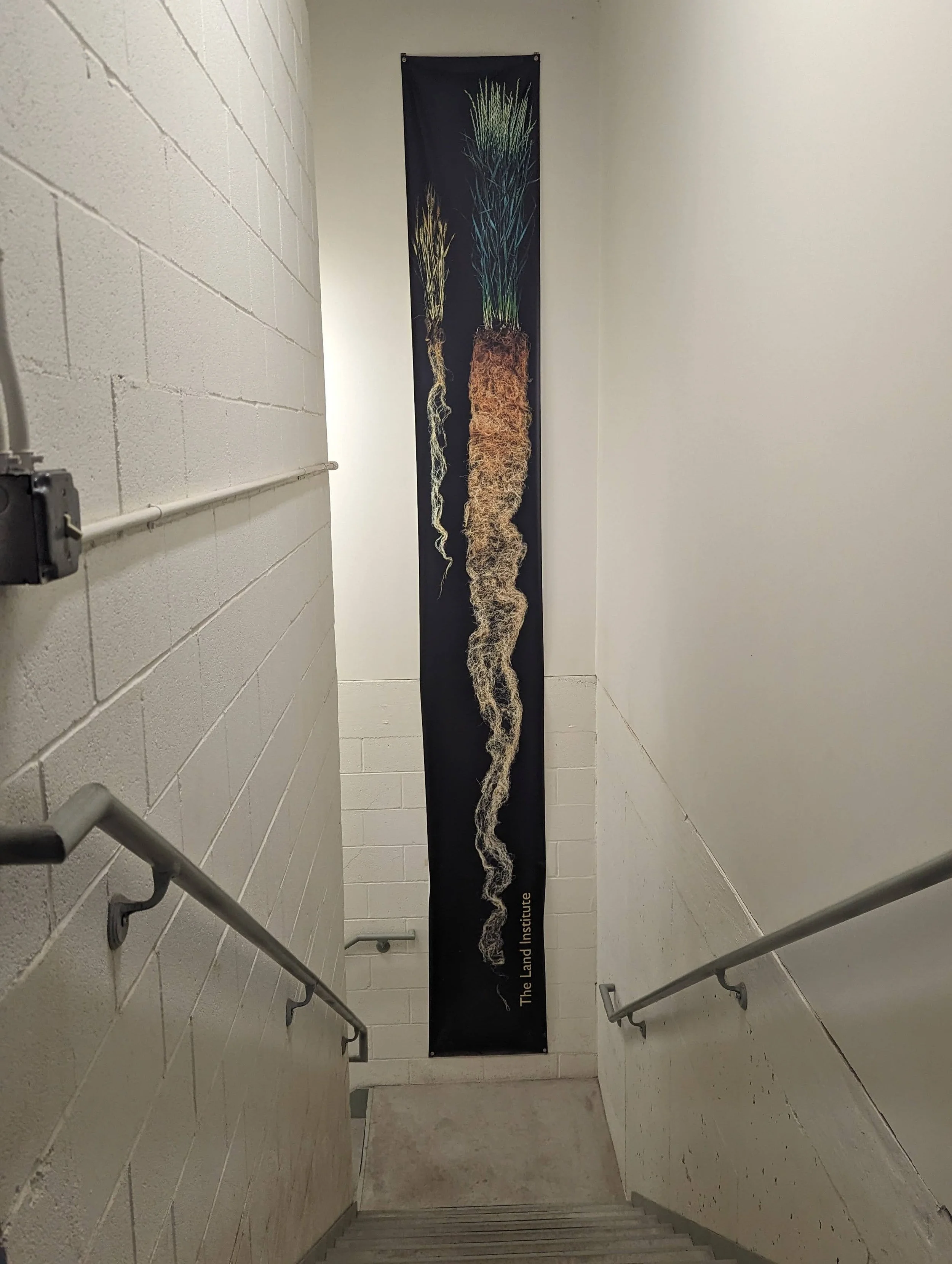
The image to the left shows the actual root system for traditional, annual wheat (left) compared to perennial wheat (right). For over 20 years, The Land Institute in Salina, KS has been working to develop Kernza®, the trademarked brand name for their perennial wheat.
Traditionally, wheat is an annual crop, meaning it is planted and harvested one time. Kernza® is designed to return year after year. When I visited the Land Institute in March 2024, they were getting three harvests out of their Kernza® crop.
This means the root system for Kernza® is able to establish itself for three years, as opposed to just one with traditional wheat. When you look at the image on the left, you can see the difference of that additional time. The Kernza® root system (right) is able to source and retain more water and nutrients, requiring less human intervention on the surface.
Less human intervention saves on labor and fertilizer and water costs, but it is also better for your soil. One of the key principles of sustainable agriculture is to keep your soil from turning into dirt. Dirt is lifeless. Soil is a living ecosystem of bacteria, bugs, nutrients, water, air - everything you need to support life. When you disturb your soil, through practices like tilling, you break up that ecosystem, leaving your soil less able to sustain plant life. Additionally loose soil is easily carried away with the wind or water, taking critical nutrients away from your field. The more you mess with your soil, the more you will need to do to keep it nutritious for your crops.
Environmental Impact
Remember photosynthesis from 2nd grade? Plants breathe in carbon dioxide and breathe out oxygen. Humans breathe in oxygen and breathe out carbon dioxide. Long story short, when plants breathe in that carbon dioxide, they store carbon in their root systems. If the soil is undisturbed that carbon stays locked in the soil, nurturing plants, for hundreds of years. This process of intentionally creating conditions to pull carbon back into the soil and keep it there is carbon sequestering. A natural or designed system that absorbs carbon dioxide from the atmosphere is a carbon sink.
Prairie lands are a carbon sink. Farm lands can be a carbon sink, if responsible farming practices are followed. Practices like tilling break up the soil microbiomes, releasing the sequestered carbon back into the atmosphere. The promise of perennial crops is that the soil and root structures can go undisturbed for multiple years, keeping the carbon in the ground where it belongs.
What Farmers Think
Moving from the research lab to real world conditions is a challenge in all industries. To get a sense of the real world potential of Kernza®, I spoke with David (pseudonym) an agronomist at Heartland Soil Services, in southeast Kansas. David’s job is to work with farmers directly in their fields, to improve their soil health. He takes soil samples to check which elements are and are not in the field, as well as checking local water sources to see what’s leaving the fields via runoff. He works with the farmers to balance their nutrients and improve water drainage to keep nutrients where they are needed. He also helps calculate their Soil Tillage Intensity Rating (STIR) value, which is a metric to help farmers understand the degree to which their practices are disturbing their soil and exposing their fields to wind and water erosion.
When asked his thoughts on Kernza®, David shared that Kernza® is really good for grazing cattle, but the yield is currently too low to replace annual wheat as a cash crop. Farming is a business and Kernza® yield is about 30% lower (as of 2024) compared to annual wheat. He is supportive of their research and hopes they can improve the yield to make Kernza® more competitive.
In the meantime, farmers can improve soil health through responsible practices like:
Crop Rotation is the process of growing different crops in the same field over time. For example, you might plant wheat in field A, then soy in field A, then a cover crop in field A, then corn in field A. When it's time to plant wheat next year, you might move it to field B. The idea is to have a multi-year plan for your fields. Different plants use different nutrients and attract different bugs. Diversity reduces nutrient depletion and allows for better soil structure, which combined with no till or low till, keeps carbon sequestered.
Reducing Tillage to minimize soil disturbance - tilling is used to remove unwanted weeds that compete with your cash crop for nutrients. Any healthy garden is going to have weeds. Organic farmers till to remove the weeds. No till farmers use chemicals (often synthetic) to remove the weeds. As a soil health expert, Nolan prefers no till farming to organic farming, as no till farming is better for the soil.
Cover Crops are crops that are planted to benefit the soil ecosystem, not to harvest for profit. Cover crops are chosen to complement the cash crop, meaning they don’t compete for resources with the cash crop seedlings. They grow quickly to block sunlight, preventing weeds from growing. Cover crops are terminated (mowing, herbicides) when the cash crop is ready to thrive on its own.
The Dust Bowl
Climate change is a divisive issue in our country, so I asked David how he approaches this topic with farmers who do not consider themselves environmentalists. He says it doesn’t really come up. Farmers want to make money. If they can help improve their yield and reduce their costs, they want to listen.
I know from my experience talking to farmers, even if they don’t want to talk about carbon sequestering, they very much believe in preventing the next Dust Bowl. Driving through southeast Kansas, you will see fields separated by treelines. Yes, these are sometimes to reinforce a property line, but more often they are windbreaks, to prevent the wind from whipping away topsoil. These farmers know all too well what happens when soil becomes dirt, and they are willing to put in the work to prevent it from happening again.
Read more about my conversations with these farmers during wheat harvest.